
SaaS SEO: The Complete Guide to Driving Revenue from Organic Search
Most SEO advice on the internet is built for e-commerce stores, local businesses, and media sites. It focuses on traffic volume, ad revenue, and one-time transactions.
SaaS is a fundamentally different business. You are selling a subscription to an intangible product. Your buyers take weeks or months to evaluate. They involve multiple stakeholders. They compare you against three or four competitors before they book a demo. And after they convert, you need them to stay — because your entire revenue model depends on retention.
That means your SEO strategy cannot be copy-pasted from a generic playbook. It needs to be built around how SaaS buyers actually search, evaluate, and purchase software.
This guide walks you through every layer of a SaaS SEO strategy that drives real revenue — from keyword research and content architecture to technical foundations and link building. Whether you are a founder doing SEO yourself or a marketing leader building a growth team, this is the playbook.
What Is SaaS SEO?
SaaS SEO is the practice of optimizing a software company’s website to rank in search engines, attract qualified visitors, and convert them into trial users, demo requests, or paying customers.
It involves the same core disciplines as traditional SEO — keyword research, on-page optimization, technical SEO, content strategy, and link building — but applies them through the lens of SaaS-specific buying behavior.
Three things make SaaS SEO different from SEO in other industries:
The buying journey is longer and involves more stakeholders. A SaaS purchase is rarely impulsive. Buyers research the problem, evaluate categories, compare specific tools, check integrations, read reviews, and often get buy-in from multiple people before committing. Your SEO strategy needs content that speaks to every stage of that journey.
The product is intangible. You cannot hold, try on, or see SaaS software on a shelf. Your content has to do the heavy lifting of demonstrating value — through case studies, feature explanations, comparison pages, and educational content.
Revenue is recurring. Unlike e-commerce, where a single transaction completes the relationship, SaaS depends on retention and expansion. SEO supports onboarding, education, and feature adoption long after the initial signup.
How SaaS SEO Differs from Traditional SEO
| Dimension | Traditional SEO | SaaS SEO |
| Goal | Sales, bookings, or ad revenue | Signups, demos, product-qualified leads, and MRR growth |
| Buying cycle | Single stakeholder, short transaction | Multiple stakeholders, weeks-to-months evaluation |
| Search behavior | Informational or transactional queries | Problem-aware, solution-aware, comparison, pricing, and integration queries |
| Content model | Blog + product pages | Feature pages, use-case pages, comparison pages, integration pages + blog for topical authority |
| Success metric | Traffic and conversions | Pipeline generated, trial-to-paid conversion, organic-sourced MRR |
Why SEO Matters for SaaS Companies
There are several growth channels available to SaaS companies — paid ads, outbound sales, partnerships, product-led growth, social media. SEO stands apart because of one unique characteristic: it compounds.
Every piece of content you publish continues to attract traffic long after you create it. Paid ads stop working the moment you stop paying. SEO keeps generating results. Here is why that matters for a SaaS business specifically.
SEO Delivers the Highest ROI of Any SaaS Marketing Channel
According to research from First Page Sage, B2B SaaS companies achieve an average ROI of 702% from SEO, with a breakeven period of approximately 7 months. For context, the median ROI across all industries is 748%, and SEO generates roughly $22 in returns for every $1 invested.
The cost difference is stark. HubSpot’s data shows that organic SEO delivers leads at approximately $31 per lead, compared to roughly $198 per lead for PPC — making SEO about 5.8 times more cost-efficient.
Organic Search Is the Largest Traffic Source for SaaS
Research consistently shows that organic search drives the majority of SaaS website visits. An analysis of the top 50 SaaS companies by researcher Mike Sonders found that organic traffic accounts for 26.4% of all traffic and is the single largest source of new visitors. Across the broader web, organic search drives approximately 53% of all website traffic.
Real-World Proof: SaaS Companies Built on SEO
HubSpot built one of the most valuable SaaS companies in history largely on the back of organic search. At its peak, HubSpot’s blog generated over 13 million organic visits per month, ranking for millions of keywords. Their content strategy directly fueled growth to over $2 billion in annual revenue. (Though their recent traffic decline — after Google penalized their off-topic content like “shrug emoji” guides — is itself a lesson: topical relevance matters more than volume.)
Ahrefs grew to over $100 million in ARR with zero outside funding, driven almost entirely by content marketing and SEO. Their blog ranks for hundreds of thousands of keywords, and their strategy of creating the most comprehensive guides on SEO topics has become a benchmark for SaaS content marketing.
NerdWallet was built almost entirely on organic search, growing into a multi-billion-dollar public company by creating comparison and review content that captured high-intent financial search queries.
These are not outliers. They are proof that SEO, executed as a system, can become the most powerful growth engine a SaaS company has.
The SaaS Marketing Funnel and Search Intent
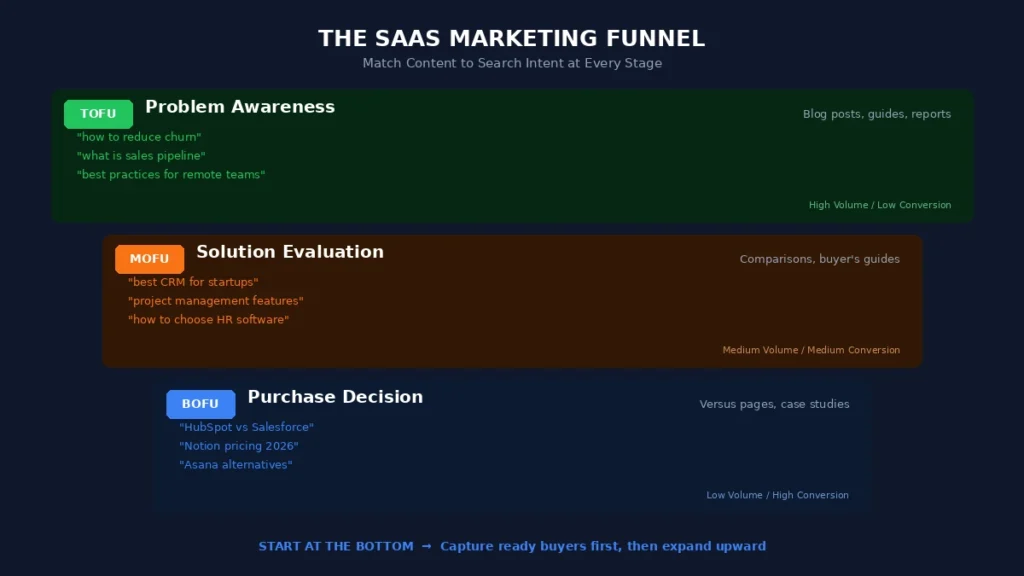
Before you touch a keyword tool, you need to understand how the marketing funnel maps to search behavior. This framework should drive every content decision you make.
Top of Funnel (ToFu) — Problem Awareness
Buyers know they have a problem but have not started looking for specific solutions.
- Example searches: “how to reduce employee turnover,” “what is customer churn,” “best practices for remote team management”
- Content types: educational blog posts, guides, industry reports
- Goal: attract potential buyers, introduce your brand, capture email addresses
Middle of Funnel (MoFu) — Solution Evaluation
Buyers know solutions exist and are actively researching their options.
- Example searches: “best CRM for startups,” “project management software features,” “how to choose an HR platform”
- Content types: comparison posts, buyer’s guides, use-case pages, feature pages
- Goal: position your product as a strong contender, educate on what to look for
Bottom of Funnel (BoFu) — Purchase Decision
Buyers have narrowed their list and are comparing specific products.
- Example searches: “HubSpot vs Salesforce,” “Notion pricing 2026,” “Asana alternatives”
- Content types: versus pages, alternative pages, pricing pages, case studies, demo landing pages
- Goal: convert visitors into trials, demos, or direct purchases
The critical insight most SaaS companies miss: BoFu keywords convert at dramatically higher rates than ToFu keywords. According to First Page Sage, approximately 8.5% of SaaS site visitors start a free trial, and BoFu pages drive a disproportionate share of those conversions. Yet most SaaS companies start with high-volume ToFu content because the search volume looks impressive.
Start at the bottom. Capture buyers who are ready to act. Then expand upward.
The Amplifion Compound Growth System: A 6-Phase Framework
Most agencies sell SEO as a list of tactics — some keyword research here, a few blog posts there, maybe a technical audit. That produces activity, not results.
At Amplifion, we build SEO as a system — an interconnected growth engine where every element reinforces every other element. We call it the Compound Growth System. Here is how it works:
Phase 1: Audit & Diagnose
Before writing a single word of content, you need to know where you stand. Audit your technical SEO health, current rankings, backlink profile, competitor landscape, and conversion performance. Identify the two or three critical fixes that will have the biggest immediate impact.
Phase 2: Map Demand to Your Product
Translate every feature, use case, integration, and problem your product solves into keyword themes. Then validate those themes against actual search data — volume, intent, difficulty, and competitive landscape.
Phase 3: Build the BoFu Foundation
Create your highest-converting pages first: comparison pages, alternative pages, category roundups, and optimized product/feature pages. These pages capture buyers who are already in the market.
Phase 4: Architect Your Content Clusters
Build hub-and-spoke content clusters around your most important topics. Each cluster has a comprehensive pillar guide (the hub) linked to focused subtopic articles (the spokes), all interlinked to build topical authority.
Phase 5: Earn Authority Through Links
Build high-quality backlinks through original research, guest posting on relevant publications, digital PR, and integration partnerships. Domain authority is the multiplier that makes all your content rank faster.
Phase 6: Measure, Iterate, Compound
Track pipeline generated from organic search — not just traffic. Use performance data to identify what to double down on and what to improve. Refresh content, expand clusters, and let compounding do its work.
This is not a one-time project. It is a system that compounds over time. The companies that execute this consistently for 12-24 months build an organic growth engine that becomes nearly impossible for competitors to replicate.
SaaS Keyword Research: Finding Keywords That Drive Signups
Keyword research for SaaS is not about finding the highest-volume terms. It is about finding the terms your ideal customer profile (ICP) actually searches when they have a problem your product solves.
Step 1: Map Your Product to Search Demand
Start by listing everything your product does, who it serves, and what problems it solves. Then translate each into search queries.
For example, Pipedrive — a sales CRM — does not just target “CRM software.” They map their product to queries across the entire funnel:
- Problem keywords: “how to build a sales pipeline,” “what is a sales funnel”
- Category keywords: “best sales CRM,” “simple CRM for small business”
- Feature keywords: “CRM with email integration,” “sales pipeline management tools”
- Comparison keywords: “Pipedrive vs HubSpot,” “Salesforce alternatives”
- Integration keywords: “Pipedrive QuickBooks integration”
This exercise gives you a keyword universe organized by intent, not just volume.
Step 2: Prioritize by Intent, Not Volume
Use a tool like Ahrefs or SEMrush to pull search volume and keyword difficulty data. But do not sort by volume. Sort by business value.
High-priority keywords meet these criteria:
- The searcher has a problem your product solves
- The intent is commercial or transactional (they are looking for a solution)
- The keyword difficulty is realistic given your current domain authority
- You can create content that is genuinely better than what currently ranks
A keyword like “project management” gets 100,000+ monthly searches, but the intent is vague and the competition is brutal. “Best project management software for creative agencies” gets a fraction of that volume, but every person searching it is a potential buyer.
Step 3: Build Your Comparison Keyword List
These are consistently the highest-converting keywords in SaaS SEO. When someone searches “[competitor] alternatives” or “[product A] vs [product B],” they are actively shopping.
Build a comprehensive list:
- [Competitor] alternatives
- [Competitor] vs [your product]
- [Competitor A] vs [Competitor B] — you can insert yourself even when you are not mentioned
- Best [category] software for [use case]
- [Category] tools for [industry/team size]
Pipedrive, for example, has dedicated pages for “Pipedrive vs HubSpot,” “Pipedrive vs Salesforce,” and dozens of other comparisons. These pages consistently drive their highest conversion rates.
Step 4: Reverse-Engineer Your Competitors
Your competitors have already done keyword research — you just need to see the results. Use Ahrefs or SEMrush to pull their top-ranking pages and keywords. Look for:
- Keyword gaps: terms they rank for that you do not
- Top pages: which content types drive their most traffic
- Weak positions: keywords where they rank 4-10 (you can potentially outrank them with better conte nt)
Content Architecture: The Hub-and-Spoke Model
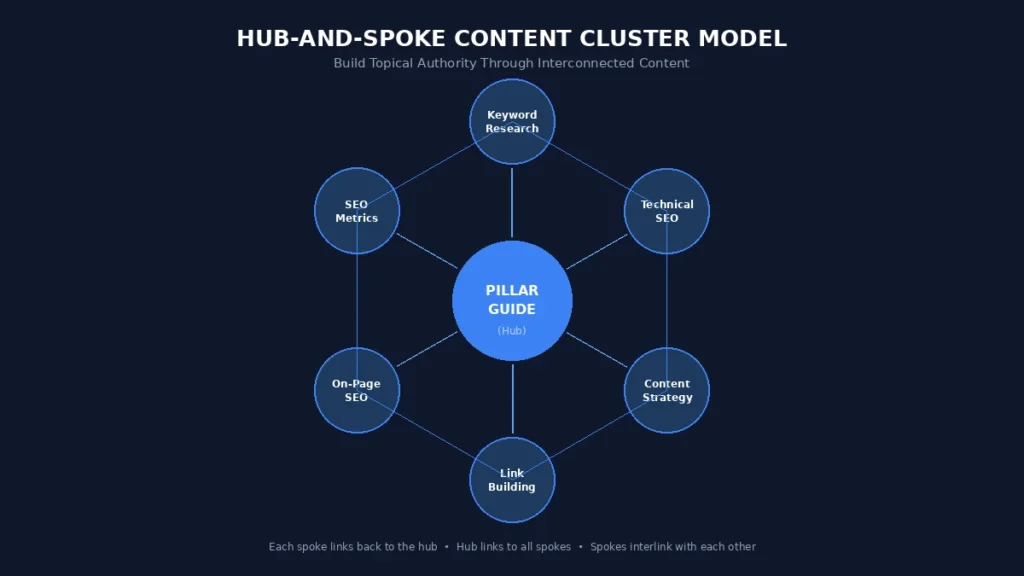
Random blog posts do not build authority. Disconnected pages do not compound. You need a content architecture — a structured system where every page reinforces every other page.
How Hub-and-Spoke Works
The hub (pillar page) is a comprehensive guide on a broad topic. It covers the subject at a high level and links to more specific articles.
The spokes (cluster posts) go deep on subtopics. Each links back to the hub and to related spokes.
HubSpot pioneered this model and used it to dominate search for almost every marketing-related topic. Their “Ultimate Guide to Technical SEO” serves as a hub, with individual chapters (crawlability, site speed, schema markup) as spokes — all interlinked.
When you build clusters like this, you signal to search engines that your site has deep expertise on the topic. This builds topical authority, which helps every page in the cluster rank higher.
Your First Cluster: Start With Your Core Category
If you sell email marketing software, your first hub might be “Email Marketing: The Complete Guide” with spokes covering deliverability, automation workflows, A/B testing, list building, and email design best practices.
Every spoke links to the hub. The hub links to every spoke. And each spoke links to two or three related spokes. This creates a web of internal links that distributes authority across the entire cluster.
On-Page SEO Checklist for SaaS Websites
On-page SEO ensures each page communicates its topic clearly to both users and search engines. Here are the elements to optimize on every page:
Title tags — Include your primary keyword naturally. Keep under 60 characters. Front-load the keyword when possible. The top three search positions capture 68.7% of all clicks, with position one alone generating a 39.8% click-through rate (First Page Sage). Your title tag heavily influences whether searchers click.
Meta descriptions — Write compelling descriptions with your keyword and a clear value proposition. These impact click-through rates significantly even though they are not a direct ranking factor.
Header structure (H1, H2, H3) — One H1 per page containing your primary keyword. H2s for major sections, H3s for subsections. This hierarchy helps search engines understand content structure and is increasingly important for AI search citations.
Internal linking — Every page should link to related pages with descriptive anchor text. Internal links distribute authority and guide users deeper into your site.
URL structure — Short, descriptive, keyword-rich. Use hyphens to separate words. Avoid dates, parameters, or category slugs.
Image optimization — Compress for fast loading. Use descriptive alt text. Name files with relevant keywords.
Schema markup — Implement FAQ schema on posts with FAQ sections. Add Article schema to blog posts. Rich results capture 58% of clicks compared to 41% for non-rich results in equivalent positions (AIOSEO).
Technical SEO: The Foundation That Makes Everything Work
If your technical foundation is broken, none of your content or optimization efforts will reach their full potential.
Site Speed and Core Web Vitals
Page speed is both a ranking factor and a conversion factor. Target:
- LCP (Largest Contentful Paint): under 2.5 seconds
- INP (Interaction to Next Paint): under 200 milliseconds
- CLS (Cumulative Layout Shift): under 0.1
Common fixes: compress images, lazy load below-the-fold content, minimize JavaScript, use a CDN, enable browser caching. Over 62% of global web traffic comes from mobile devices, so mobile performance is critical.
Crawlability and Indexation
Ensure your XML sitemap is submitted in Google Search Console, robots.txt is not blocking critical pages, canonical tags are correctly implemented, and there are no orphan pages. Duplicate content issues from URL parameters, session IDs, or pagination can waste crawl budget.
JavaScript Rendering
Many SaaS websites use React, Angular, or Vue for their marketing sites. If content renders client-side, search engines may not see it. Use server-side rendering or static site generation, and verify indexation in Google Search Console.
HTTPS
Every page must load over HTTPS. Non-negotiable for rankings and for the trust SaaS buyers expect when evaluating business software.
Link Building for SaaS: Earning Authority
Backlinks remain one of the strongest ranking signals. Content marketing is the most effective link building strategy — 68% of companies use it, according to Aira’s survey data. Case studies were the top-performing format, with 62% of technology marketers ranking them as their best link earner.
Five Strategies That Work
1. Publish original research. SaaS companies that publish original research see an average 18.7% increase in SEO traffic (StrataBeat). Industry surveys, benchmark reports, and data analyses give other sites a reason to link to you.
2. Build free tools. Ahrefs and HubSpot generate thousands of backlinks through free tools like webmaster tools, graders, and calculators. A free ROI calculator or diagnostic assessment for your niche creates a permanent linkable asset.
3. Guest post on relevant publications. Write for the outlets your ICP reads. One contextual link from a niche-relevant publication outweighs ten links from generic sites.
4. Get listed in partner directories. Integration partnerships create natural backlink opportunities. App marketplace listings are contextual, high-authority links.
5. Pursue digital PR. Pitch proprietary data and unique findings to journalists. Data-driven stories earn links from news outlets and trade publications.
Optimizing for AI Search and GEO
In 2026, SEO includes optimizing for AI-powered search experiences. Google’s AI Overviews now appear in approximately 31% of search results (First Page Sage), and tools like ChatGPT, Perplexity, and Gemini are becoming discovery channels for software buyers.
Structure content with direct answers. AI systems extract from content that clearly answers questions. Use specific headings, concise definitions, and structured formats.
Build topical depth. AI systems favor comprehensive, authoritative sources. Hub-and-spoke clusters signal the expertise AI models prioritize when selecting citations.
Consider an llms.txt file. This emerging standard (proposed by Jeremy Howard) tells AI crawlers which content matters most on your site.
Publish what AI cannot replicate. Original research, proprietary frameworks, and expert analysis are more likely to be cited by AI as primary sources. Generic advice gets skipped.
7 Common SaaS SEO Mistakes
1. Starting with ToFu instead of BoFu. High-volume informational keywords attract visitors far from buying. Start with comparison and alternative pages that capture ready buyers.
2. Ignoring search intent. Always check the current SERPs before creating content. If Google shows product pages for a query and you publish a blog post, you will not rank.
3. Publishing thin content at high frequency. Two expert-level articles per month outperform eight shallow posts. SaaS buyers are sophisticated and can tell the difference.
4. Neglecting technical SEO. Great content will not rank on a slow, poorly indexed site. Audit technical foundations before investing heavily in content.
5. Ignoring internal links. Only 19% of SaaS companies actively optimize underperforming pages, yet doing so can lift sitewide traffic by 10-15%.
6. Treating SEO as a project, not a system. HubSpot, Ahrefs, and Zapier have been executing SEO consistently for years. That is why they dominate.
7. Not connecting SEO to revenue. Set up attribution to track which organic pages drive demos, trials, and revenue. Traffic reports without revenue context are meaningless.
Measuring SaaS SEO: The Metrics That Matter
| Metric | What It Tells You | Why It Matters |
| Organic-sourced pipeline | Demos, trials, or leads from organic search | The number your CEO cares about |
| Organic traffic to conversion pages | Visitors on pricing, demo, and trial pages | Decision-stage traffic drives revenue |
| Keyword rankings (commercial terms) | Positions for comparison and category terms | Ranking improvements translate to pipeline |
| Organic conversion rate | % of organic visitors who convert | Growth without conversion = CRO problem |
| Backlink growth | New referring domains earned monthly | Leading indicator of future ranking gains |
Essential Tools for SaaS SEO
Keyword research & competitive analysis: Ahrefs or SEMrush. Pick one and learn it deeply.
Technical auditing: Screaming Frog. Free version handles up to 500 URLs.
Content optimization: Clearscope or Surfer SEO for topic coverage analysis.
Performance monitoring: Google Search Console (free, essential) plus Google Analytics or Plausible.
The most important tool is not software — it is a monthly review process where you analyze what is ranking, what is converting, and what needs improvement.
Your SaaS SEO Roadmap
Month 1-2: Foundation. Technical audit, tracking setup, BoFu keyword research. Publish first comparison and alternative pages. Optimize core product pages.
Month 3-4: Content engine. Launch first content cluster (pillar + 4-6 spokes). Begin publishing 2-4 posts per month. Start link building.
Month 5-6: Expansion. Second content cluster. MoFu content — buyer’s guides, frameworks, use-case articles. Scale link building.
Month 7-12: Compounding. Continue publishing. Refresh early content. Expand into ToFu. Build linkable assets. Early content should be ranking and traffic compounding.
SaaS SEO Is a Revenue Channel, Not a Traffic Channel
HubSpot learned this lesson publicly. At their peak, they generated over 13 million organic visits per month. But when Google penalized their off-topic content — shrug emoji posts, celebrity trivia, famous quotes — their traffic dropped by more than 50%. The content that survived and recovered was the material directly connected to their product and expertise.
Every keyword you target should connect to your product. Every page should have a clear path to conversion. Every piece of content should serve a purpose in your buyer’s journey.
When you build SEO around revenue outcomes — not keyword rankings, not traffic volume, not domain authority scores — you build a growth system that compounds over time and becomes increasingly difficult for competitors to replicate.
That is the power of SaaS SEO done right.